

Export
Peaking Capacity
Firm MW from aggregated home batteries for daily peaks, resource adequacy and reliability calls. Each node is registered with its duration, ramp and derates, so the resource table shows what you can count on.
Kora for Utilities
Kora Fleet Management embeds dispatchable storage on the distribution feeders where your load actually sits, behind the meter at thousands of homes, instead of one utility-scale battery at a substation miles away. The same megawatts for your operators to dispatch around the clock, with feeder and transformer relief built in and no transmission interconnection queue to wait through.
Running now
Daily peak · 5:00 to 8:00 PM · interval 3 of 12
Requested 10.5 MW at 4:12 PM, confirmed 10.4 MW at 4:12:41 PM. Shortfall 0.05 MW at S12, under the 5% notice threshold.
Dispatch
Kora confirms deliverable MW within 60 seconds.
Built on listed hardware and open standards
Every event in Kora Fleet Management runs as one of four services. Your planners pick the service, the node and the window; the fleet allocates it across homes with owner reserves, opt-outs and must-have circuits already removed, so the MW you confirm is the MW you get.
Export
Firm MW from aggregated home batteries for daily peaks, resource adequacy and reliability calls. Each node is registered with its duration, ramp and derates, so the resource table shows what you can count on.
Export or charge, by node
Dispatch to a feeder, transformer or substation area, not just a system-wide total. Relieve constrained circuits, defer upgrades and keep every allocation under the export and charge ceilings you set.
Load reduction
The Kora Smart Panel controls circuits, not just the battery. Hold a home's net import at a target by shifting HVAC and EV charging, without touching the lights or the fridge.
Load increase and solar release
Charge on command to soak up midday solar on export-constrained feeders, then lift PV export caps when the grid can take the power.
Dispatch from the Kora utility portal, or from your own DERMS over IEEE 2030.5 or OpenADR 2.0b, any hour of any day. Kora confirms the MW it can deliver within 60 seconds. The confirmation can be less than the request, and never more than the fleet can carry.
Grid limits
Every allocation stays under these. Overrides apply at once.
| Export ceiling, MW | Charge ceiling, MW | |
|---|---|---|
| S07 | 7.5 | 5.0 |
| S12 | 6.0 | 4.0 |
| S21 | 3.5 | 2.5 |
Event records
Interval-level files for settlement
| Event | Confirmed | Delivered | Status |
|---|---|---|---|
| Aug 16 · daily peak · 5 to 8 PM | 10.2 MW | 10.0 MW | In dispute |
| Aug 15 · daily peak · 5 to 8 PM | 10.4 MW | 10.4 MW | Accepted |
| Aug 14 · feeder relief · S12 · 6 to 7 PM | 2.0 MW | 2.0 MW | Accepted |
| Aug 12 · test · S07 · 10% scale | 0.5 MW | 0.5 MW | Test, passed |
Two ways to build the fleet
The fleet engine does not care who made the battery. Run it on Kora hardware we deploy and maintain, on the devices your customers already own, or on both at once, under one set of programs, events and settlement files.
Kora hardware
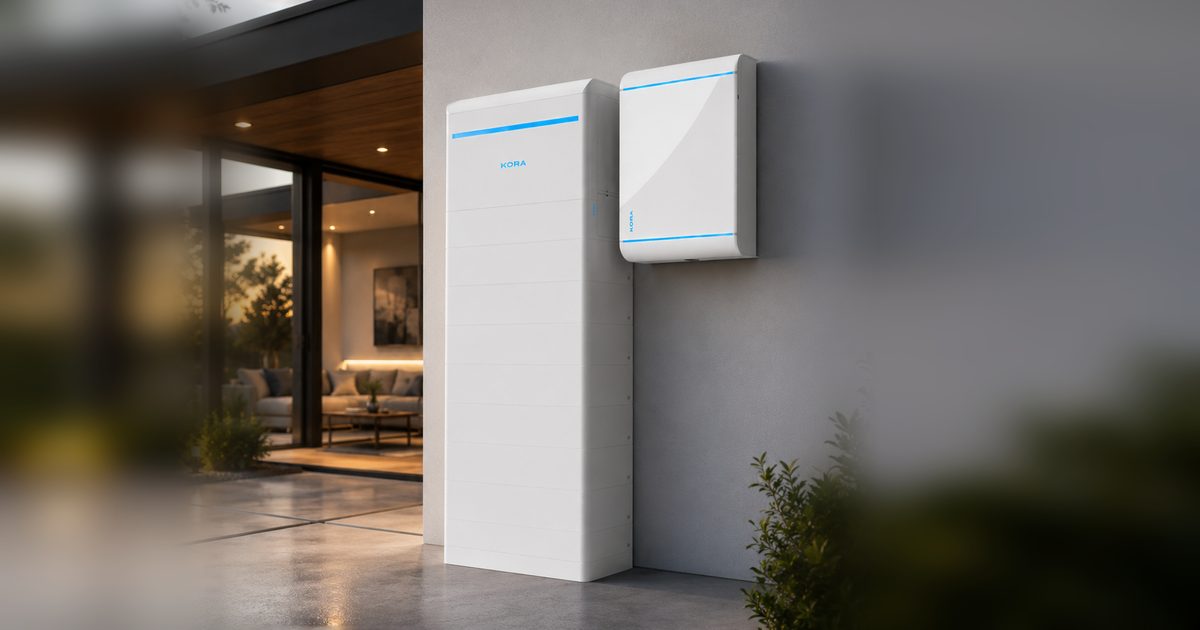
Smart Panel, Powerblocks and a hybrid inverter, installed in hours at the home's existing service point, or as in-grid units where a program calls for front-of-the-meter capacity. Kora deploys, owns, finances and maintains the fleet. Hosts keep backup power and a monthly credit.
Software platform
Kora Fleet Management as the VPP layer for the distributed devices in your territory, connected through OEM cloud APIs and open standards. One registry, one event engine, one ledger, whatever the mix of brands.
Services included
The same platform runs every market Kora operates in: utility programs, demand response and wholesale trading. Your program gets all of it.
01
Every system with its node, service size and meter point, confirmed by the installer before it can be mapped. State is recomputed on every change and at least every five minutes.
02
Preview an allocation before you commit. Owner reserve, opt-outs and must-have circuits come out first, and the largest single command is capped at a share of the fleet.
03
Delivered against confirmed, per interval, with 2-second telemetry where a market requires it and a tolerance check between local and cloud readings.
04
Day-ahead availability by node, sent on your schedule, with forecast error tracked against a target and weather alerts feeding storm holds.
05
Nodes, feeders and interconnection points on one map, each with its export and charge ceiling, live headroom and the systems behind it.
06
Interval-level event records, settlement files and performance against the contract: availability, forced outage rate and response time, with host credits accounted for.
Programs: the contract every event runs under.
Event windows, notice, ramp caps, cycles a year, pay terms and your escalation contacts, encoded once and enforced on every allocation.
Utility-scale storage is dispatchable but far from the load. A traditional battery VPP sits at the load but answers only when its program calls. Kora is built to be both.
| Kora fleet | Utility-scale storage | Traditional battery VPP | |
|---|---|---|---|
| Dispatchable 24/7 | Yes | Yes | Event windows only |
| Dispatch by node or feeder | Yes | One site | Rarely |
| Homeowner backup power | Yes, reserve protected | No | Yes |
| Panel-level load control | Yes, 12 circuits per panel | No | No |
| Runs third-party devices | Yes | Not applicable | Varies |
| Connects at | Existing service point, or in-grid | New interconnection | Existing service point |
| Option for utility ownership | Yes, build and transfer | Yes | No |
Commercial structures
Pick the structure that fits your IRP, RFP or bilateral procurement. Every one of them gives your operators dispatch rights.
Kora owns and operates the fleet. You pay per kW-month for available capacity, reduced pro rata if availability falls below the contract floor.
Kora deploys and commissions the fleet, then transfers ownership to you. Your operators dispatch; Kora stays on for software and service if you want it.
Run your own VPP on Kora Fleet Management: your devices, your program rules, your brand on the customer app. Pricing on request.
Kora enrolls owners in your demand response program as their aggregator, allocates every event across them and shares the payment with the homes.
A fleet only works if the homes trust it. These rules apply in every market Kora operates in, and owner settings always win.
Backup reserve first
Every home keeps a reserve, 20% by default. Normal events never go below it; reliability calls may, only where the owner opted in.
Opt out from the app
Owners can sit out an event from the Kora Power App. Opt-outs come out of the allocation before you see the confirmed MW.
Storm hold
On a National Weather Service warning the fleet prompts a storm hold, so homes go into the weather full.
Must-have circuits
Medical equipment, a freezer, a well pump: circuits marked must-have on the Smart Panel are planned around, never shed.
Kora Power App
SampleGrid event tonight
Your utility asked for help from 5:00 to 8:00 PM. Your home is in.
You do. Dispatch from the utility portal, or over IEEE 2030.5 or OpenADR 2.0b from your DERMS, any hour of any day. Kora confirms deliverable MW within 60 seconds and reports delivered power per interval. You keep full visibility of fleet state, availability and delivered power.
Yes. Kora Fleet Management connects third-party batteries, EV chargers, thermostats, water heaters and inverters through OEM APIs and open standards, and runs them under the same programs, events and ledger as Kora systems. Ask us about the specific brands in your territory.
Kora systems connect behind the meter at the home's existing service point, so most deployments need no new interconnection agreement or substation work. In-grid, front-of-the-meter units are available where a program calls for them. Installers confirm node, service size and meter point in the installer app before a system can be mapped.
Yes, from the Kora Power App. Every home also keeps a backup reserve, 20% by default, and normal events never draw below it. Opt-outs and reserves are removed from the allocation before Kora confirms MW to you, so the confirmed number already accounts for them.
Interval-level event records per node, availability and forced outage reporting against the contract floor, response times, and a dispute window defined in the program. Files export as CSV or over the API.
It depends on program size and where the fleet starts. Existing devices can be enrolled as soon as owners consent. Kora installs take one to three hours each and are scheduled by node, so capacity arrives feeder by feeder rather than all at the end. Ask the utility team for a plan sized to your program.